Treasure Valley sun & heat
Intense UV and big day-night temperature swings bake and cycle shingles, drying the asphalt and loosening granules faster than the label years assume.
Start with install year and material to see where your roof sits in its lifecycle. It's a fast planning read — but age is only half the story. The real answer for your roof takes about a minute.
Likely in an early-to-mid lifecycle window if maintenance has kept up. A good time to establish a baseline.
Age is an estimate. Your roof score is the real answer.
A free Roof Report reads your actual roof — condition and local storm history — in about a minute. One address, no phone.
Estimates use typical service-life ranges for the Treasure Valley climate. Real remaining life depends on condition, ventilation, and storm exposure — a Roof Report measures those directly.
The number on the calculator assumes an average roof. These are the things that push your roof toward the top or bottom of its range — and each one is something a Roof Report accounts for.
Intense UV and big day-night temperature swings bake and cycle shingles, drying the asphalt and loosening granules faster than the label years assume.
Every wind and hail event chips away at service life. Two roofs the same age can be years apart depending on what's blown through.
Poor ventilation traps heat and moisture, cooking shingles from beneath. Well-vented roofs routinely reach the top of their range; starved ones fall short.
Nailing, underlayment, flashing, and starter details decide whether a roof lives to its full life or fails early at the edges and penetrations.
Low slopes and spots that pond or stay shaded hold water and debris, aging those areas faster than the sunny, fast-draining field.
Cleared valleys, sound sealant, and prompt small repairs add years. Neglected flashing and clogged gutters quietly subtract them.
Material sets the baseline. These are general planning ranges — your actual number lands where your roof's condition and local storm history put it.
Not sure which one you have, or where yours really sits? A Roof Report answers both.
Three-tab asphalt
Entry-level, single-layer shingle
Architectural asphalt
The most common modern shingle
Designer laminate
Premium multi-layer profiles
Standing-seam metal
Long-life, low-maintenance
These show up close-up long before a roof looks bad from the ground. Spot one or two and it's time for a real read.
Edges lift or the center dips as shingles dry out and lose flexibility — a classic late-life tell.
Bald, shiny asphalt patches and granules piling at downspouts mean the protective layer is wearing thin.
Fine surface cracks and shingles that snap instead of flex signal the mat is aging out.
Dips in the roofline or a spongy deck point to moisture and structural wear underneath.
Wherever the calculator lands you, the smart next move is the same size of effort — one free Roof Report.
Pull a free Roof Report now so you know your true starting point and can catch small issues before they cost you.
Get a Roof Report around storm season — condition and local hail history decide whether it's a tune-up or a plan.
Start planning now and check whether a storm-claim window applies. A Roof Report flags both in about a minute.
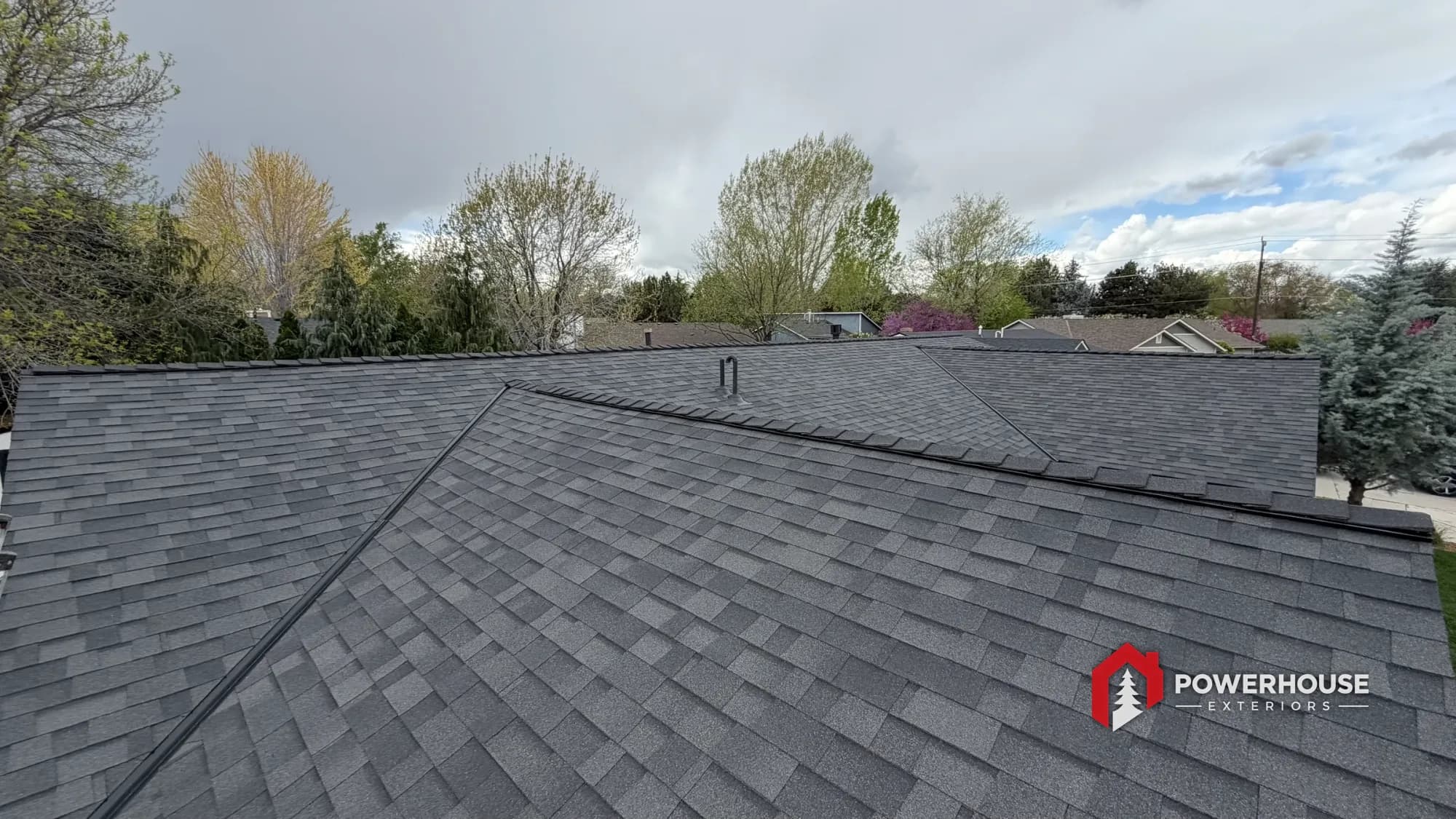
This Treasure Valley home's roof had finally reached the end — worn out and tarped to hold back leaks. Drag to compare the failing original with the finished replacement our crew installed.
Every project photo here is real PowerHouse Exteriors work — not stock imagery.
 Aged out
 Replaced
The calculator estimates from age alone. A free Roof Report reads your actual roof — condition framing plus local storm and hail history for your address — and turns it into a clear next step. One address, about a minute, no phone number.
It's a solid starting point, but only that. Two roofs installed the same year can be years apart in real condition depending on sun exposure, ventilation, workmanship, and what storms have rolled through. Age tells you when to look closely; a Roof Report tells you what's actually there.
Ground-level looks are reassuring but incomplete. Granule loss, brittle shingles, and worn flashing usually show up close-up long before the roof looks bad from the yard. If your roof is in the Watch or Urgent band, it's worth a real read.
No. Even young roofs take hail and wind damage, and claim windows are tied to the storm date, not the roof's age. A Roof Report adds your local storm history so you know whether a recent event is worth acting on.
Check closing documents, permit records with your city or county, a prior inspection report, or ask the previous owner. If you can't pin it down, a Roof Report can estimate condition directly — no install date required.
Age alone doesn't make the call. Pair it with a Roof Report for local weather context and a real next step.
See pricing guidance